Intensifying floods, record heatwaves and large‑scale disruptions to infrastructure and supply chains in Asia underscore the urgency of scaling adaptation and resilience. Yet global adaptation finance today falls far short of estimated needs of around USD 310 to 365 billion annually by 2035. Current policy environments have not effectively catalysed capital flows into adaptation and resilience, and there is an urgent need to connect policy ambition with practical investment solutions.
To bridge this gap, AIGCC established its Physical Risk and Resilience (PRR) Working Group in 2021 to enable investors to navigate physical risk challenges and strengthen engagement on resilience planning with corporates and policymakers in the region.
Driving policy enablers for investible National Adaptation Plans
Clear, investible National Adaptation Plans (NAPs) are foundational to mobilising private capital. AIGCC has published Investor Expectations on National Adaptation Planning in Asia, which lists key elements that would help facilitate more collaboration between the public and private sector on adaptation financing. Our assessment of adaptation plans and policies across nine Asian markets against these investor expectations revealed significant barriers to private investment, including fragmented and inconsistent physical risk information, and a need for clearer adaptation priorities and coordinated strategies.
Building on this evidence base, the Working Group has deepened investor-led policy engagements on resilience planning and financing, including but not limited to Mainland China, Hong Kong, India, Indonesia, Japan, Malaysia, Singapore and South Korea. Discussions in these markets have focused on addressing adaptation information gaps through data platforms and embedding financial sector engagement in adaptation planning and roadmaps. Working Group members have also provided inputs to major policy consultations, such as India’s Climate Finance Taxonomy, the prototype of the Hong Kong Taxonomy for Sustainable Finance (Phase 2A) and the UNFCCC’s Baku to Belém Roadmap to 1.3 Trillion. Through the Working Group – now comprising over 40 institutional investors – AIGCC members are committed to working closely with governments to scale understanding and action on adaptation planning.

Director of Policy Anjali Viswamohanan briefing stakeholders on the Physical Risk and Resilience work programme at AIGCC’s policy roundtable on adaptation finance in Singapore in May 2025. Image by AIGCC.
Strengthening investor capacity for stewardship on adaptation and resilience
Alongside enabling policy frameworks, resilience planning requires coordinated efforts across the private sector. Through the Working Group, AIGCC continues to enhance investor capacity to understand emerging market practices on resilience planning and develop tools to support effective engagement with companies on resilience planning. Recent working group sessions have explored investible opportunities and financing instruments in resilience, scenario analysis, and adaptation strategies for real assets.
In partnership with the MSCI Institute, we assessed the physical risk exposure and resilience readiness of over 2,400 power generation assets in Asia’s electric utilities sector. The study highlighted significant present-day risks to utilities particularly due to extreme heat and precipitation, and maturity gaps in resilience disclosures and implementation. These insights will support further investor-led dialogues on sector-specific resilience planning with companies in our Asian Utilities Engagement Program (AUEP) and Climate Action 100+ programmes.
Amplifying investor perspectives at global forums
While investors made progress to quantify and integrate physical climate risks across their portfolios, scaling adaptation finance at the pace and scale requires coordinated action and strategic partnerships across governments, corporates and capital providers.
At the 62nd session of the UNFCCC Subsidiary Bodies in Bonn in June 2025, AIGCC had the unique opportunity to brief negotiators on approaches that the finance sector is adopting to enable climate resilient development and to ensure its integration in transition planning.
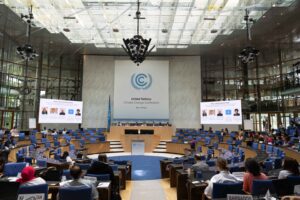
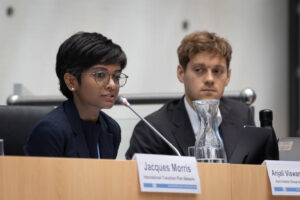
Director of Policy, Anjali Viswamohanan was part of an expert panel convened under the First Workshop in 2025 under the Sharm el-Sheikh Dialogue on the scope of Article 2, paragraph 1(c), and its complementarity with Article 9 of the Paris Agreement which was a mandated event for Parties to the Paris Agreement. Photo by IISD/ENB – Kiara Worth
At COP30 in Belém, AIGCC co-organised and participated in high-level sessions alongside investors, philanthropies, multilateral institutions and the COP30 Presidency focusing on scaling adaptation finance across the continuum of capital. Discussions underscored the importance of delivering credible, bankable project pipelines through NAPs and integrating supply chain and transboundary risks. With commitments to triple adaptation finance by 2035, we will continue to represent Asian investor perspectives in global adaptation and resilience dialogues to accelerate adaptation implementation.

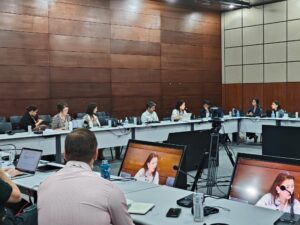
AIGCC convened representatives across the capital spectrum – asset owners and managers, multilateral development banks, philanthropies and policymakers at COP30 in Belém, Brazil. These include co-hosting an adaptation finance session in partnership with Ecosperity at the Singapore Pavilion and a high-level roundtable on mobilising the continuum of capital for financing resilience in partnership with the COP30 Presidency, Laudes Foundation, ClimateWorks Foundation and Impact Europe. CEO Rebecca Mikula-Wright and Director of Policy Anjali Viswamohanan (pictured) led and participated in discussions on mobilising capital for adaptation and resilience. Image credit: COP30 Singapore Pavillion, MSCI Institute.
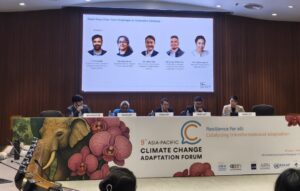
Policy Analyst Jeffrey Tong (pictured) presented insights on the barriers and enablers in adaptation finance at a discussion co-organised by the Council on Energy, Environment and Water (CEEW) and the UK FCDO at the 9th Asia-Pacific Adaptation Forum in Bangkok in October 2025. Image credit: CEEW.
Looking ahead
AIGCC is committed to deepening investor-led engagements that will:
- build investor capacity for effective stewardship engagements together with companies on corporate resilience planning to collectively unlock capital for climate resilience.
Learn more about the PRR WG